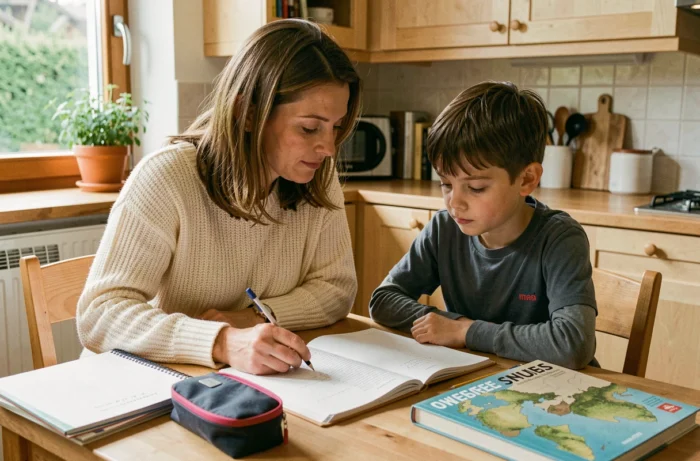
The Swiss school system is based on a federal structure in which each canton sets its own curricula, calendars and promotion requirements. For parents, this decentralisation means that the support available varies depending on where they live, their child’s school level and the pathway they are considering. Between compulsory schooling, choosing a post-compulsory route and finding available resources, the options are not always clear at first glance.
Understanding cantonal differences in the Swiss school system
A student attending school in Geneva does not follow exactly the same path as a student in Fribourg or Basel. The names of school levels, promotion requirements and admission thresholds for upper secondary education differ from one canton to another. This can make things difficult for families who move or compare options in neighbouring cantons.
Before considering which direction to take, the first step is to identify the specific rules in the canton where the child attends school. Official cantonal websites publish promotion criteria, registration calendars and admission requirements for post-compulsory pathways. This information is updated regularly, sometimes from one year to the next.
In several French-speaking cantons, the end of the 11th year is when students choose between general education (gymnasium or school of general education) and vocational education (a CFC or AFP apprenticeship). Admission criteria for gymnasium, for example, are not the same everywhere: some cantons require a minimum average grade, while others hold an entrance exam. Checking the admission requirements in your canton helps avoid unpleasant surprises at the end of the school year.
To help navigate this complexity, parents can access resources from Réseau Éducation Suisse that explain cantonal differences and make it easier to follow their child’s school journey.

Choosing a path after compulsory schooling: apprenticeship, gymnasium or transition programme
After compulsory schooling, the Swiss system offers three main pathways. General education (gymnasium, business school or school of general education) prepares students for higher education. An apprenticeship (CFC or AFP) combines practical training at a company with theoretical classes at a vocational school. Transition programmes support students who have not yet decided on a career path or have not secured a place.
An apprenticeship does not close any doors
A persistent misconception is that an apprenticeship is a second-choice option. The Swiss system tells a different story. A CFC gives students access to the vocational baccalaureate and then to universities of applied sciences. There are also pathways to university for holders of a vocational baccalaureate who pass an additional examination.
At this stage, parental support involves more than choosing a pathway. An apprentice’s daily routine, split between the training company, vocational school and sometimes inter-company courses, requires adjustment. Talking with your child about their workload, schedule and work-life balance is part of the parental role, well beyond signing the apprenticeship contract.
Explore careers before choosing
Work experience placements (sometimes called “taster placements”) give students the chance to spend a few days in a real professional setting. The orientation.ch portal lists professions and training programmes available in Switzerland. Supporting your child as they explore means helping them put into words what they observed and what they liked or disliked, without steering their conclusions.
- Use orientation.ch to identify careers that match your child’s interests, not just their academic results
- Arrange taster placements in at least two different fields to broaden their horizons
- Make an appointment with the school’s careers adviser, who knows the local requirements and registration deadlines
Recognising learning difficulties and finding the right support
Learning difficulties are not always immediately apparent. A gradual drop in grades, a marked lack of interest in certain subjects or repeated tension around homework may indicate a need for specific support. Learning difficulties are not evenly distributed across social backgrounds, making early identification all the more important.
Every school has dedicated support staff, including the class teacher, a school mediator, a school psychologist and a speech therapist. The first step is to speak with the teacher to understand the nature of the difficulty before seeking outside support. Organisations such as Caritas offer parental support to families who are unfamiliar with the Swiss school system or face language barriers.
Private tutoring and coaching are also available, but they do not replace communication with the school. Regular conversations with the class teacher remain the most direct way to tailor support at home.

Artificial intelligence at school: what parents can clarify
The growing use of artificial intelligence tools by students raises new questions for families. Some schools have begun issuing guidance on using these tools for schoolwork, but the rules vary from one school to another and are changing rapidly.
Parents can take three practical steps. First, find out what the school’s guidelines are: is AI allowed for some assignments and prohibited for others? Next, talk with your child about the difference between using a tool to understand a concept and asking it to do the work for them. Finally, encourage them to check AI-generated information, which may contain factual errors.
Distinguishing between support for learning and replacing independent work is a skill children will not develop on their own. This conversation takes time, but it helps them learn to use AI responsibly beyond the classroom.
Day-to-day school support: focus on your child’s actual needs
International surveys show that Switzerland’s education system continues to perform well overall, although results vary by subject. A child may do well in science but struggle with languages, or the other way around. Support is most effective when it focuses on a child’s individual needs rather than applying a one-size-fits-all approach.
In practice, this means observing how your child works, identifying the subjects they find difficult and adapting support accordingly. A child who understands the theory but struggles in exams may need help with stress management or study techniques, rather than more practice exercises.
The Swiss school system offers opportunities to change direction at every stage, and few choices are final. Pathways between programmes exist precisely to make it possible to adjust course. Supporting your child also means reminding them that choosing a path at 15 does not determine the rest of their life.