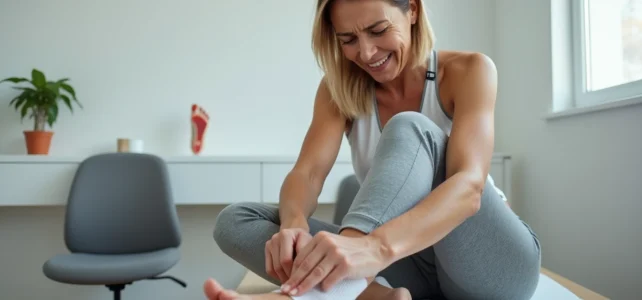
When heel pain persists despite weeks of home care, the problem rarely stems from a lack of effort. Ice is applied, over-the-counter insoles are purchased, walking is limited, and yet the pain returns every morning with the first step.
In most cases, it is not the treatment that is ineffective, but rather the approach that misses its target. The calcaneal spur, this small bony growth under the heel, draws all the attention while the source of the pain often lies elsewhere.
Calcaneal spur and plantar fasciitis: a confusion that delays healing
Patients often focus their treatment on the visible bony spur seen on X-rays, while the pain originates from inflammation of the plantar fascia. The small calcified hook shown in imaging is a consequence, not the cause. This distinction changes everything in the choice of care.
Treating the spur itself (repeated local injections, ultra-rigid insoles focused solely on the heel) without addressing the tension in the fascia is like treating the rust on a car body without sealing the water leak. Inflammation of the plantar aponeurosis, this fibrous membrane stretched between the heel and the base of the toes, remains active as long as the mechanical tension that causes it is not reduced.
To identify the solutions for the calcaneal spur suitable for each situation, it is essential to first understand whether the pain is related to enthesopathy (damage to the insertion area) or to a more diffuse irritation of the fascia. A podiatric or medical examination can clarify this.

Three common mistakes that perpetuate heel pain
Prolonged complete rest
The instinct is to avoid putting the foot on the ground. One stays seated, avoids any walking, and waits for it to pass. Prolonged immobility worsens the stiffness of the plantar fascia and the calf. When resuming activity, the accumulated tension causes even sharper pain.
Current approaches favor a gradual return to weight-bearing. Walking for a few minutes on soft ground, gradually increasing the distance, maintaining minimal foot mobility each day. The goal is not to force, but to prevent the tissues from retracting.
Inappropriate shoes despite good cushioning
Buying a pair with a thick cushion under the heel is not enough. Effectiveness depends on the combination of three elements: heel cushioning, arch support, and flexibility of the forefoot. A highly cushioned shoe but flat under the arch keeps the fascia in constant tension.
Feedback on this point varies according to foot morphology, but one rule holds in most cases: a slight heel-to-toe elevation reduces tension on the fascia. One should look for a shoe that slightly elevates the heel compared to the forefoot, not a flat sole even if it is soft.
Ignoring the muscle chain above the foot
The plantar fascia does not work alone. It is mechanically connected to the Achilles tendon and the gastrocnemius (calf muscles). A tight calf constantly pulls on the heel and keeps inflammation active. Massaging only the sole of the foot without stretching the calf addresses only half of the problem.
Calf and plantar fascia stretches: the duo that truly relieves
Targeted stretches form the foundation of conservative treatment. Their effectiveness relies on consistency, not intensity.
- Calf stretch against a wall: back foot flat, knee straight, push the pelvis forward for about twenty seconds. Repeat several times a day, especially before the first steps in the morning.
- Fascia stretch while seated: cross the painful ankle over the opposite knee, then gently pull the toes towards the shin until feeling tension under the arch. Hold the position calmly.
- Roller or ball under the arch: while seated, roll a ball (tennis or spiky) under the foot with moderate pressure. This action mobilizes the fascia without aggression.
These three combined exercises affect the entire muscle-tendon chain from the calf to the toes. Practiced daily, they reduce morning stiffness in a few weeks for the majority of people.
Orthopedic insoles and medical treatment: when to consult
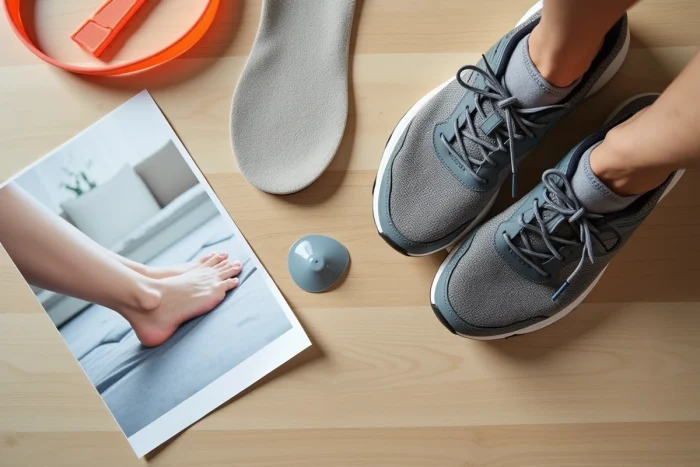
When stretches and shoe adjustments are insufficient after several weeks, a podiatric assessment is necessary. Custom orthopedic insoles do not just cushion the heel. They correct the distribution of weight across the entire foot and reduce the tension exerted on the plantar fascia with each step.
An effective insole includes calibrated arch support, a pressure relief area under the heel, and sometimes a corrective element for the rear foot if it collapses inward. Adaptation must be personalized, not simply chosen by size from a pharmacy shelf.
On the medical side, graduated options exist for resistant cases:
- Extracorporeal shock waves, which stimulate healing of the fascia through controlled micro-traumas
- Corticosteroid injections, reserved for very debilitating pain and limited in number to avoid tissue weakening
- Targeted physiotherapy with eccentric calf work and strengthening of the intrinsic foot muscles
- As a last resort, surgery (partial release of the aponeurosis), rarely necessary when conservative management is well conducted
Heel pain related to plantar fasciitis responds well to conservative treatment in the vast majority of cases, provided the right target is aimed for. Treating the fascia and the calf chain rather than the bony spur itself remains the tipping point between months of pain and lasting improvement.