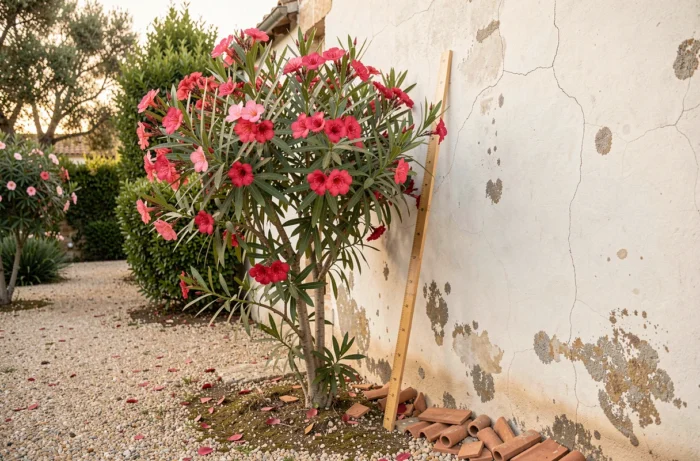
Planting a oleander near a wall may seem trivial, but the chosen distance affects the health of the shrub, the integrity of the building, and compliance with the Civil Code. Between the recommended horticultural setback for flowering and the legal setback imposed at the property boundary, these values do not always coincide. This article compares these distances, identifies the parameters that cause them to vary, and specifies the concrete risks when the oleander is too close to a wall.
Legal setback and horticultural setback for oleander: comparative table
Two logics coexist. The Civil Code sets minimum distances from the property boundary between two properties. Horticultural recommendations, on the other hand, aim for the plant’s healthy growth and the preservation of the wall. Here are the reference values derived from the regulatory context and documented feedback.
| Situation | Minimum distance | Basis |
|---|---|---|
| Planting maintained at 2 m in height or less, at the property boundary | 50 cm from the center of the trunk | Articles 671 to 673 of the Civil Code |
| Planting intended to exceed 2 m, at the property boundary | 2 m from the center of the trunk | Articles 671 to 673 of the Civil Code |
| Espalier-trained oleander against a separating wall | No imposed distance (must not exceed the top of the wall) | Exception provided by the Civil Code |
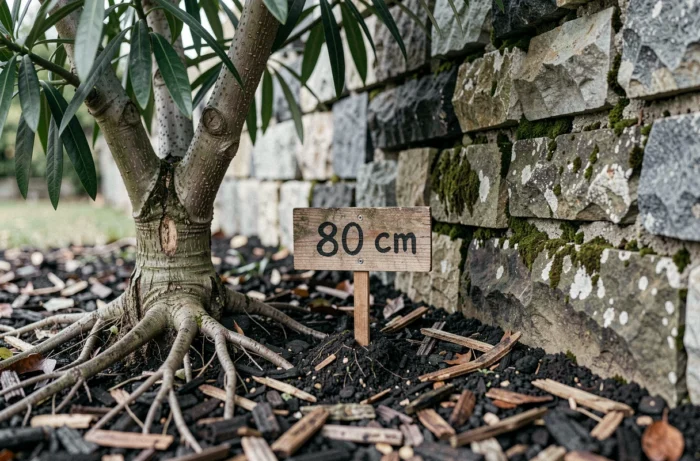
| Recommended horticultural setback from a house wall | 80 cm to 1 m | Feedback (source: mediajardin-groupej.com) |
| Recommended setback if buried pipes are nearby | 1.5 to 3 m | Feedback (source: mediajardin-groupej.com) |
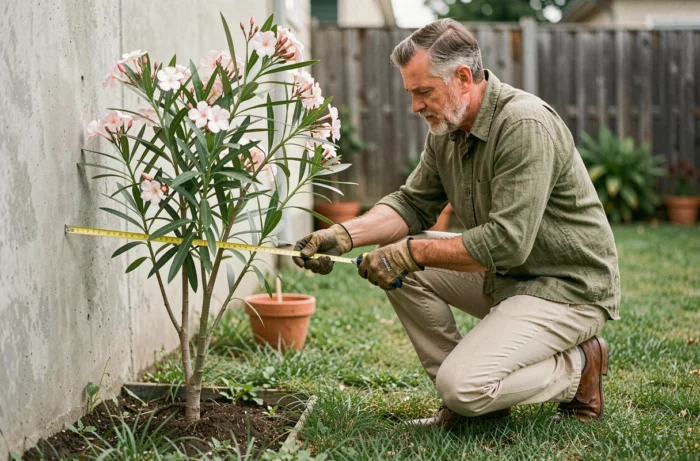
The measurement is always taken from the center of the trunk, not from the edge of the foliage. This precision changes everything: an adult oleander can spread its branches well beyond the legal measurement point.
To understand the ideal distance between oleander and wall and the root behavior that justifies it, it is essential to clearly distinguish the wall located on your own land from the wall at the property boundary, as the obligations differ.
Private wall or separating wall: why the distance changes
Articles 671 to 673 of the Civil Code only concern the boundary between two properties. A wall located entirely on your property is not subject to these legal distances. You can technically plant an oleander 30 cm from your own facade without violating the Civil Code.
The problem then becomes horticultural and structural, not legal. An oleander pressed against a private wall lacks air circulation, which encourages stagnant moisture and fungal diseases. Pruning becomes complicated on the wall side. Flowering decreases on the compressed branches.
However, as soon as the wall marks the boundary with the neighboring land, the legal distances apply. If you plan to let your oleander exceed 2 m in height, the 2 m setback from the center of the trunk is mandatory. The neighbor can demand removal or reduction in case of non-compliance.
The particular case of the espalier
An oleander trained as an espalier along a separating wall escapes ordinary distances, provided that the vegetation does not exceed the top of the wall. This exception requires strict maintenance: branches tied, regular pruning, no overhang into the neighboring property. The espalier does not exempt from protecting the wall against moisture trapped between the foliage and the wall.
Buried pipes and oleander roots: the safety margin
The roots of the oleander are not known for lifting massive foundations. Their main danger concerns pipes. A micro-leak in a pipe, even a simple poorly done joint, attracts the roots toward the source of moisture. Once infiltrated, they cause blockages and then breaks.
The recommended setback when pipes are nearby is 1.5 to 3 m, which is much more than the 80 cm to 1 m advised for a simple wall without buried networks. Before planting, locating the path of the pipes is a precaution that avoids costly unblocking or replacement work.
- Requesting the plan of buried networks from the town hall or local urban planning department allows for locating water, sewage, and gas lines.
- Installing a high-density polyethylene root barrier between the oleander and the pipe limits lateral root extension.
- Opting for a potted or container-grown oleander against a wall if pipes are less than 1.5 m away: the container naturally blocks the progression of roots.
Humidity, ventilation, and flowering: the concrete effects of insufficient setback
An oleander pressed against a wall does not die, but it grows poorly. The evergreen foliage retains moisture between the wall and the plant, especially on a wall exposed to the north or with little sunlight. On a plaster surface, this chronic moisture causes green stains, peeling paint, and even infiltrations into the building.
A setback of 80 cm to 1 m allows air circulation around the shrub and leaves enough space to prune the wall side without contortion. The oleander flowers on the wood of the year: branches pressed against a wall produce few flowering shoots.
In the ground, the oleander appreciates well-drained soil. The foot of a wall often accumulates runoff water, creating excess moisture at the root level. Slightly raising the root ball at planting or improving drainage with gravel at the bottom of the hole limits this risk.
The varietal factor
Not all varieties have the same bulk. Dwarf or compact oleanders remain under 1.5 m in height and spread less. A vigorous specimen of a classic variety can reach several meters wide. Choosing a variety suited to the available space reduces the frequency of pruning and conflicts with the wall.
The distance between an oleander and a wall thus depends on three intersecting parameters: the legal nature of the wall (private or separating), the presence of buried pipes, and the planted variety. The only value that satisfies the Civil Code, horticulture, and the prevention of damage to networks remains a minimum setback of 1 m for a wall without pipes, increased to 1.5 m or more as soon as a pipe passes through the area.