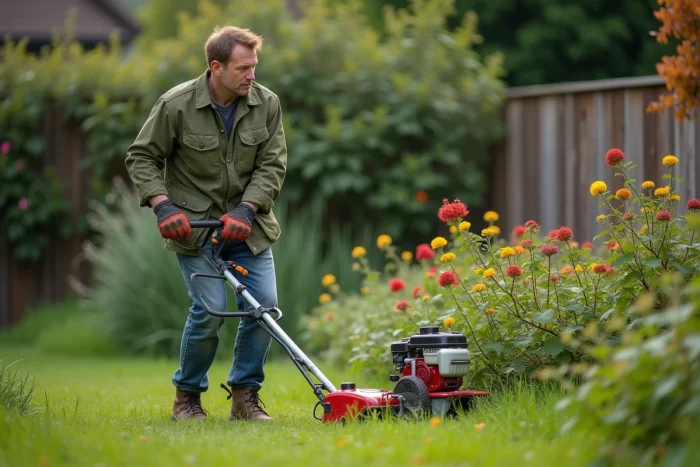
No thermal brush cutter fits all terrains or uses. A powerful model may prove useless on small areas, while a lightweight device quickly reaches its limits on a bramble-infested terrain. The diversity of engines, cutting heads, and safety devices makes comparison complex, even for the most knowledgeable.
Technical criteria, often presented as secondary, directly influence performance and durability. Some accessories, rarely included by default, significantly modify the user experience and the final cost. Therefore, selecting a model should rely on a thorough understanding of needs and constraints.
Understanding your garden’s needs: what criteria to consider before choosing?
First and foremost, it is essential to examine your terrain closely. The choice of a thermal brush cutter is based on the reality of the soil, the type of grass, the thickness of the underbrush, and the presence or absence of brambles and shrubs. Maintaining a small patch of grass or tackling an overgrown underbrush: two worlds, two machines.
The area to be treated weighs heavily in the decision. On a large, uneven, or sloped terrain, it is necessary to opt for a sturdy model with a generous engine. For finishing touches and edges, a lightweight machine is often sufficient. Tools offering interchangeable heads, nylon line, blade, or disc are welcome to adapt to the diversity of plants.
It is difficult to ignore the legal framework. In France, brush clearing is mandated in many departments, particularly to limit fire risks. The equipment must allow for effective and timely action. Failing to comply with these obligations exposes one to fines.
To gain clarity in the jungle of references, there are useful online resources. The site https://www.top-debroussailleuse-thermique.com offers a detailed overview of models, crossing power, maneuverability, accessories, and price ranges. Taking the time to compare each technical specification, away from marketing trends, allows for accurate targeting and investment in a suitable machine over the long term.
Thermal brush cutter: advantages, limitations, and differences from other models
The thermal brush cutter stands out in difficult terrains. Its internal combustion engine develops a force that tackles brambles, bushes, and even thick vegetation. Where electric tools stop, it continues. No cord to trip over, no battery to monitor, just gasoline in the tank and the freedom to operate over large areas, even uneven ones.
Two families of engines dominate: 2-stroke and 4-stroke. The 2-stroke, lighter, is easier to handle but requires a gas-oil mixture, generates noticeable noise, and produces more fumes. The 4-stroke, more economical in emissions and compliant with Euro 5 standards, runs on regular gasoline but has a higher weight. It is hard to ignore the noise impact and the vapors that accompany the power.
For clarity, here are the contexts where each type excels or falls short:
- For clearing a wasteland or mowing thick grass, the thermal brush cutter remains the reliable choice.
- For edges or light maintenance, other, more maneuverable options are better suited.
- The backpack model reduces fatigue during long sessions, while wheeled versions move effortlessly over bumpy terrains.
Investing in a thermal brush cutter is betting on longevity and the ability to face any challenge. It is a choice to prioritize for those who regularly maintain large spaces or work in landscaping. One should not neglect maintenance, nor overlook safety and environmental regulations. Considering these constraints helps avoid many inconveniences during use and inspections.

Practical tips for comparing and selecting the ideal brush cutter according to your use
To choose the thermal brush cutter that suits you, start by accurately estimating the area to be treated and the type of vegetation. An open meadow requires only a nylon line head, while brambles and small shrubs demand a blade or disc head. Regarding the engine, beyond 30 cm³, most underbrush does not stand a chance.
Several practical aspects deserve special attention:
- Weight: over several hours, a few hundred grams can feel heavy. A comfortable harness and an adjustable handlebar really help maintain endurance.
- Safety accessories: noise-canceling helmet, goggles, and gloves protect against both projectiles and noise.
- Starting system: an assisted device makes life easier, especially with a sometimes temperamental 2-stroke engine.
Be sure to check the sturdiness of the drive shaft, the quality of the protection cover, and the reliability of the cutting system. Machines equipped with a reduction angle conical coupling transfer power better, a real advantage on tall grass or thickets. Maintenance goes beyond just gasoline: cleaning the air filter, monitoring the line level, or sharpening the blades all prolong the life of your device. To juggle between different tasks, a convertible brush cutter, capable of switching from nylon line to blade, adapts to all seasons and challenges.
When faced with wild grasses or stubborn brambles, the right tool makes all the difference. A thoughtful choice promises hassle-free weekends and a pristine terrain, ready to host projects, games, or simply the pleasure of a well-kept garden.