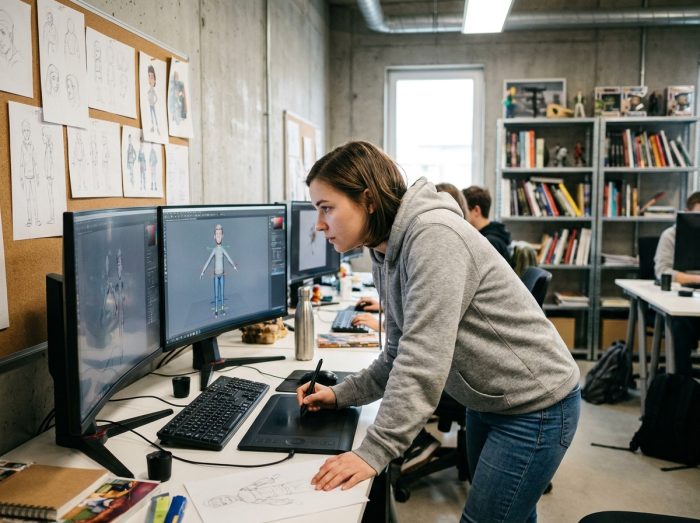
Drawing and cinema share a common foundation: storytelling through images. When these two passions converge towards 3D animation, the choice of curriculum becomes a balancing act between artistic depth and technical specialization. The available pathways, from DN MADE Animation to specialized master’s programs, do not target the same skills or career opportunities. Comparing their structures allows one to identify which best values a profile already rooted in drawing and cinematic culture.
DN MADE Animation, bachelor’s, master’s: what each degree really covers
The three main pathways into the sector are distinguished not only by their duration. Their educational content directs the courses in very different directions, especially for a profile that already draws and understands cinematic language.
| Criterion | DN MADE Animation (3 years, public) | Bachelor Animation 3D (3 years, private) | Master Animation 3D (5 years, private) |
|---|---|---|---|
| Post-bac access | Yes, via Parcoursup | Yes, entrance exam or application | After a bac+3 |
| Place of drawing | Central from the 1st year | Variable depending on the school | Reduced, focus on production |
| Cinema storytelling | Integrated into the program | Occasional modules | Final project |
| RNCP certification | License grade (State recognized) | According to Qualiopi certification | According to RNCP certification |
| Indicative cost | University fees | Significant private fees | High private fees |
DN MADE Animation integrates cinematic storytelling from the first year, which distinguishes it from production-oriented bachelor’s programs. For a profile that already masters the basics of drawing, this public pathway avoids revisiting overly elementary artistic fundamentals.
Private bachelor’s programs vary greatly from one school to another. Some dedicate the first year to a preparatory entertainment course combining drawing, visual culture, and software introduction. Others dive straight into 3D modeling with little room for storytelling.
Choosing a 3D animation curriculum suited to a dual drawing-cinema profile thus involves a detailed examination of the first-year program, not just the final degree.
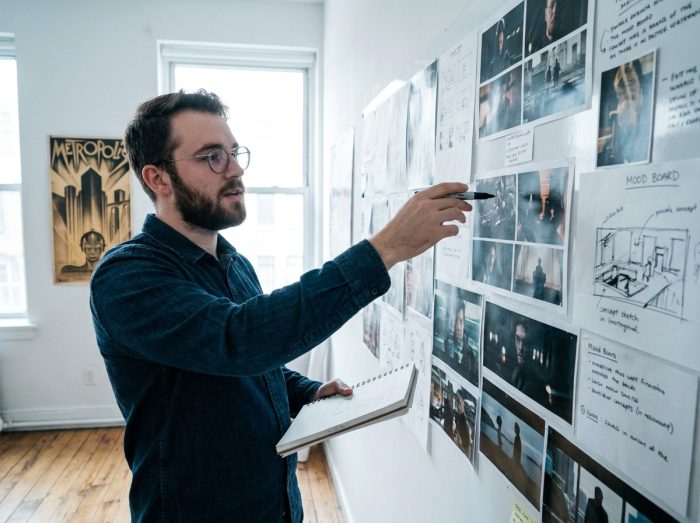
Qualiopi and RNCP certification: a decisive filter for 3D animation programs
Since the extension of Qualiopi certification to 3D animation bachelor’s programs, a clear divide separates certified private training from those that are not. This certification conditions access to CPF funding for apprentices, a significant financial lever when tuition fees at private schools reach several thousand euros per year.
Not all private 3D animation schools have RNCP certification. A degree not listed in the National Directory of Professional Certifications has no value recognized by the State, even if the school enjoys a good reputation in the professional field.
For a student passionate about cinema, the recognition of the degree weighs heavily when applying to an animation or VFX studio. Recruiters rarely check the RNCP level, but funding mechanisms (apprenticeship, CPF) are directly linked to it. A non-certified program closes these doors.
What to check before enrolling
- The RNCP sheet of the degree on the France Compétences website, detailing the validated skill blocks and the level of qualification awarded
- The presence of Qualiopi certification for the training organization, a condition for eligibility for public funding and apprenticeships
- The professional insertion rate published by the school, distinguishing jobs in 3D animation from related positions (graphic design, motion design)
Generative AI modules in animation schools: an emerging criterion
Since the beginning of 2025, several animation schools have introduced modules focusing on generative AI applied to artistic preproduction. Tools like Stable Diffusion or Midjourney are now used to accelerate concept art and visual research phases.
Generative AI does not replace drawing; it modifies the preproduction chain. A student who knows how to draw uses these tools differently than a purely technical profile: they use them to iterate faster on visual intentions they already know how to formulate by hand.
This type of module directly concerns those passionate about drawing and cinema. The ability to direct a generative tool relies on a solid visual culture, exactly the background that these profiles already possess. Conversely, schools that have not yet integrated these modules risk training animators out of sync with the current production pipelines of studios.
Soft skills and resilience in VFX studios
Working conditions in animation and VFX studios include periods of intensive production. Some schools have begun to integrate soft skills modules focused on stress management and resilience as early as bac+3. This is not a detail: the ability to maintain a sustained production pace is part of the skills expected by recruiters.
Drawing-cinema profile: the concrete choices to make before Parcoursup
A candidate who regularly draws and consumes cinema with an analytical eye has two advantages for admission juries: a well-stocked portfolio and the ability to discuss visual storytelling. The question is not whether they will be admitted, but in which program they will progress the most.
The choice lies between deepening the artistic dimension or accelerating the technical one. The DN MADE favors the former option with a strong grounding in image culture. Private bachelor’s programs favor the latter, with a quick immersion in modeling, rigging, and rendering software.
- If the portfolio mainly contains observational drawing and storyboards, a curriculum that extends this culture (DN MADE, art prep) consolidates the fundamentals before specialization
- If the candidate is already self-taught in 3D (Blender, Maya), a specialized bachelor avoids revisiting basics they have mastered
- If the goal is to create animated films, a five-year master’s program with a final project for a feature film constitutes the most direct path to studios
The ideal curriculum for a drawing-cinema profile is not the most prestigious or the longest. It is the one whose first-year program corresponds to what the candidate does not yet know how to do, not to what they already master.