
A parent calling because they can no longer access their Ameli account, a retired neighbor wanting to send photos to their grandchildren without going through an intermediary: it is often from these concrete situations that the question of digital support for seniors arises. Senior Surfers offers an original approach, based on peer support, to help elderly individuals use the internet and its tools in their daily lives.
Online administrative procedures: the first concrete barrier for seniors
Since the strengthening of France Services and Aidants Connect programs, those over 60 have become a priority target for digital inclusion plans. Tax declarations, making medical appointments, checking retirement statements: the majority of administrative procedures now require going online.
On the ground, it is these mandatory uses that trigger requests for help. Before wanting to use social networks or play online games, a senior first needs to know how to connect to a secure portal, retrieve a password, or download a document. It is precisely in these practical situations that Senior Surfers’ services intervene, offering support tailored to each person’s pace.
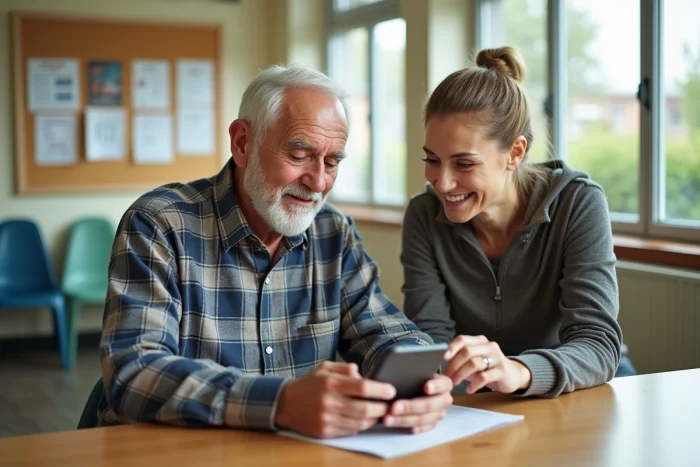
The model is based on a simple principle: it is senior volunteers, who have themselves gone through these learnings, that assist their peers. This “between seniors” logic changes the dynamic. One is no longer faced with a rushed trainer speaking technical jargon, but with someone who encountered the same difficulties a few months or years earlier.
Senior digital support: beyond administration, the pleasure of use
Reducing senior support to just e-administration misses a clear trend. Feedback from digital inclusion associations published between 2023 and 2025 indicates a significant increase in requests related to creative and leisure uses.
Sharing photos with family, video conferencing with distant relatives, discovering cultural content through streaming: these “pleasure” uses often motivate more than a tax form. When supporting a senior with photo editing or sending a video to their grandchildren, the technical learning almost goes unnoticed.
Three categories of uses that come up most often
- Health and administrative procedures: making appointments on Doctolib, checking test results, tracking retirement or tax files online
- Family and social exchanges: using messaging, social networks, and video conferencing to maintain connections with loved ones, including at home
- Digital leisure: online games, reading on tablets, creating photo albums, discovering music or video platforms
Senior Surfers covers these three areas without prioritizing them. The idea is to start from the expressed need of the person, not from a fixed program.
Peer training and remote support: what sets Senior Surfers apart
Many organizations offer computer workshops for seniors. What distinguishes Senior Surfers lies in two concrete choices.
The first, as mentioned: support from trained senior volunteers. Patience and understanding of obstacles are not the same when the supporter has also discovered the internet later in life. Feedback varies on this point depending on profiles, but most beneficiaries describe a more natural climate of trust than in a traditional workshop.
The second choice focuses on continuity. Rather than occasional in-person sessions, the model incorporates remote support that reduces travel. For a person with reduced mobility or living in a rural area, this aspect changes everything. A twenty-minute video call to solve a specific problem replaces a one-hour trip to the nearest media library.

Technologies and tools adapted for seniors
Support is not limited to “learning the internet.” It takes into account the equipment used. Tablet, smartphone, computer: each device has its specifics, and the proposed solutions adapt to the existing equipment of the person.
We do not ask a retiree to buy new equipment to follow a training session. The idea is to work with what they already have, even if it means adjusting accessibility settings (font size, contrast, simplifying the home screen).
Digital inclusion of seniors: a collective responsibility
The inclusion of elderly individuals in the public strategy confirms that the issue goes beyond the associative framework. Programs like France Services or Aidants Connect cover the territory, but they are not enough to meet all needs, especially for isolated individuals at home.
It is in this space that initiatives like Senior Surfers find their place. They complement the public offer with more flexible, personalized support, and above all, focused on human relationships rather than technical devices.
- Family caregivers find a support: instead of explaining everything themselves (often a source of tension), they can direct their loved one to a trained volunteer
- Local authorities can rely on this type of service to reach audiences who do not frequent traditional digital reception places
- Seniors themselves transition from the status of “aided person” to that of potential future supporter, which enhances their self-esteem and autonomy
Digital support for connected seniors is not just about a computer class. It is about removing specific barriers, at the right moment, with the right person in front. The Senior Surfers model shows that a senior who has crossed the threshold can become the best ally of someone who is still hesitant.