
A beta-hCG level twice the average does not necessarily indicate a twin pregnancy. Some patients have high values without expecting twins, while others, pregnant with twins, show levels close to the norm for a single pregnancy.
Reference ranges vary by laboratory, and the individual evolution of the beta-hCG level remains unpredictable from one pregnancy to another. A reliable interpretation requires cross-referencing multiple measurements and considering the clinical context. The implications of these results concern both medical follow-up and support for future parents.
What is the purpose of beta-hCG testing and how to interpret it in early pregnancy?
The beta-hCG, detectable very early in the blood, marks the establishment of pregnancy. Its measurement through a blood test is not limited to proving the presence of an embryo: it allows for tracking the progress of gestation, week by week. Produced by the trophoblast as soon as implantation occurs, this hormone rises rapidly, generally doubling every two to three days during the first weeks.
The urine pregnancy test only indicates the presence of the hormone, but only the blood test specifies the exact amount. Expressed in UI/L, this figure provides benchmarks: a low value may suggest an ectopic pregnancy or an uncertain beginning, while a high level, especially outside the usual ranges, prompts consideration of a twin pregnancy or an unusual progression. The analysis remains delicate. Values fluctuate from one woman to another, from one pregnancy to another.
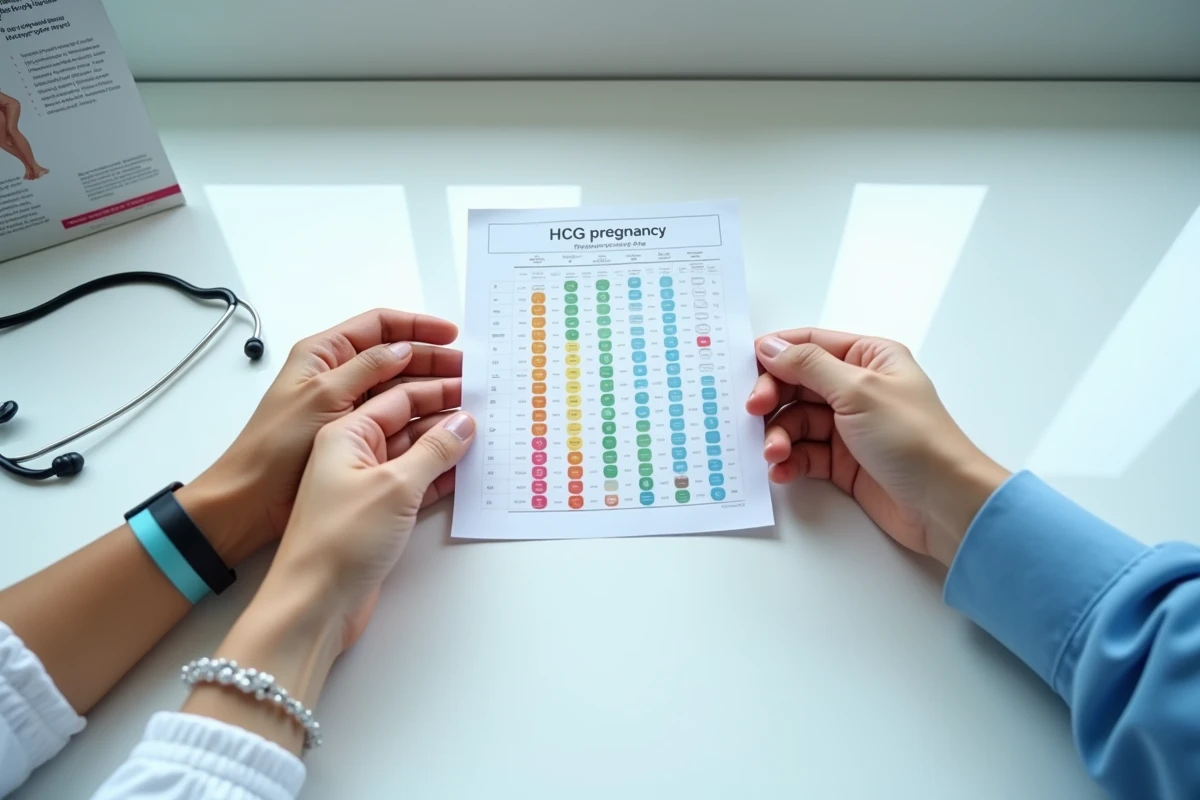
To better understand these variations, it is useful to consult a table of hCG levels for twin pregnancies: one can observe ranges often wider than for a single pregnancy. When a level surprises, repeating the measurement after 48 hours, along with an ultrasound, refines understanding. Medical follow-up is then necessary to distinguish between multiple pregnancies, molar pregnancies, or simple physiological variation.
Professionals use this information to anticipate potential difficulties and adjust support. Understanding the dynamics of beta-hCG, its rises and plateaus, precisely illuminates the first weeks, a period filled with questions for both patients and caregivers.
Table of hCG levels for a twin pregnancy: benchmarks and developments week by week
In a twin pregnancy, the hCG level in the blood rises faster and higher than in a single pregnancy. Hormonal production intensifies, and the week of pregnancy influences the reading of the level, which can evolve dramatically. Knowing how to read these numbers is already preparing for what comes next.
Many laboratories offer indicative ranges. For a multiple pregnancy, the beta-hCG is often at least double the expected values for a single pregnancy. By the fourth week, levels frequently range between 200 and 5,000 UI/L. By the sixth week, they generally vary between 10,000 and 100,000 UI/L. This jump reflects the vigor of embryonic development.
Here are frequently observed benchmarks according to the week of pregnancy:
- 4 weeks: 200 to 5,000 UI/L
- 6 weeks: 10,000 to 100,000 UI/L
- 8 weeks: up to 200,000 UI/L, with significant individual variability
The second blood test after 48 hours highlights the dynamics of the level: if the value doubles quickly, it reinforces the hypothesis of a twin pregnancy. Keep in mind that these figures remain indications. Only an ultrasound can confirm the presence of multiple embryos. Monitoring the hCG level complements this diagnosis, clarifies the evolution, and guides medical surveillance step by step through the early weeks of a twin pregnancy.
What do high hCG levels mean for future parents? Explanations and advice for navigating this stage calmly
Learning that your hCG level is high often triggers a cascade of questions. With a twin pregnancy, this chorionic gonadotropin hormone rises significantly. This increase indicates the presence of two embryos or more and particularly strong placental activity in early pregnancy. The numbers regularly exceed those of a single pregnancy but are marked by significant individual diversity.
Future parents face a series of results that can be concerning. A high level does not necessarily predict upcoming difficulties: it is primarily a biological marker of the healthy progression of the pregnancy. In rare cases, it may also indicate a molar pregnancy or another anomaly, which necessitates enhanced monitoring and additional examinations. The ultrasound, on the other hand, is the reference examination to determine: it allows for visualizing and confirming a multiple pregnancy or ruling out this possibility.
Advice for approaching this period calmly
Some simple recommendations can help maintain confidence and navigate these weeks with serenity:
- Maintain dialogue with your healthcare professional: only regular monitoring allows for correct interpretation of variations in hCG levels.
- Do not draw hasty conclusions based on a urine test or a single blood test: it is the evolution of the level that matters most.
- Prepare for closer monitoring, with frequent ultrasounds and additional analyses.
- If you experience unusual symptoms, pain, or bleeding, contact your doctor without delay.
Whether it’s a single or twin pregnancy, each journey engages the body, emotions, and imagination. The hCG level, far from being a solitary arbiter, becomes a marker to follow, never writing alone the story you are about to live.